

H195/L100/W50
1,225,000 UZS
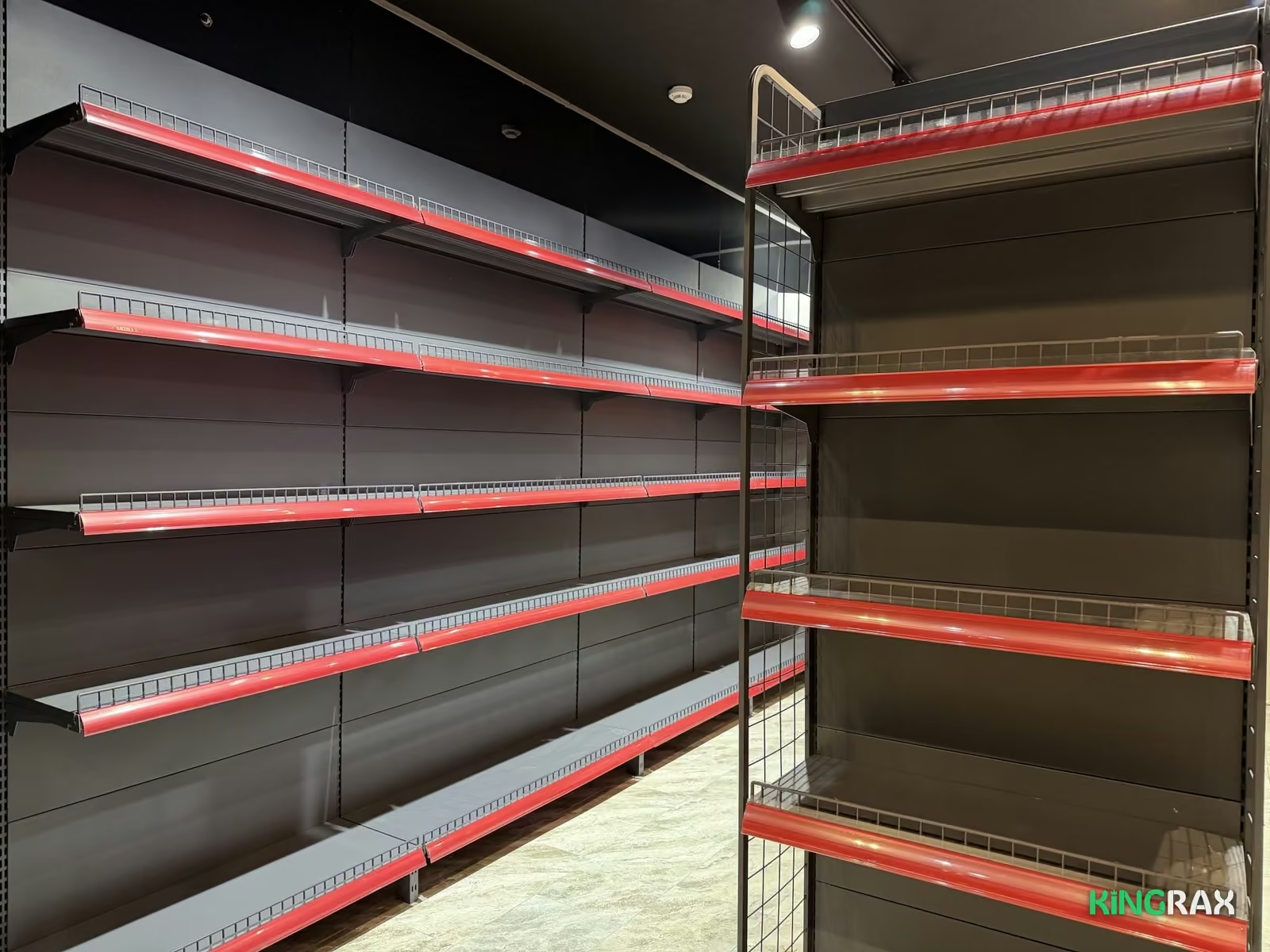
A stall in a covered market is small and open at the front: customers see the goods straight from the aisle. So goods go along the three walls and the front stays clear. Tall units along the walls, corner units in the corners, small goods on hooks.
| Place | Product | Price, UZS |
|---|---|---|
| Back wall | Wall Shelving H195/ | 1,286,000 |
| Back corners | Inner Corner Shelving H195 | 1,286,000 |
| Side walls | Wall Shelving H195/ | 980,000 |
| Small goods | Hook for a Perforated Panel W30 | 24,000 |
Prices as of 14 November 2026.
Space on a stall is tight, so small packaged goods hang on hooks: that frees the shelves and shows the goods better.
If the stall grows or takes over the one next door, a new unit is added to the run: factory shelving is assembled from parts.
Metal shelving is for dry rooms: use outdoors or in damp places isn't covered by the warranty. A stall in a covered market is fine, but if the roof leaks or water collects when the floor is washed, keep the shelving's feet dry. Shelving stands on a level floor and is fixed as the instructions say: shelving that isn't fixed isn't covered by the warranty. More detail: Assembling and using shelving safely.
3 m from the front to the back wall and 3 m wide (9 m²). By the calculator's rules: one L120 on the back wall, inner corner units in both back corners and one L70 on each side wall; the front stays open for customers.
| Calculator total, 35/30 | Qty | UZS |
|---|---|---|
| Wall shelving H195 | 3 | 3,246,000 |
| Inner corner shelving H195 | 2 | 2,572,000 |
| Uprights at the row ends | 3 | 552,000 |
| Total | 6,370,000 |
Hooks, panels, stoppers and price holders come on top. If the stall is 3.5 m deep, L120 units fit on the side walls: 6,982,000 UZS in all.
Tell us the stall dimensions and which side is open, and in a free 2D/3D layout we'll work out the shelving layout and price. Shelving: Wall Shelving, Inner Corner Shelving; hooks and panels: Shelving Accessories.


Enter the length of a wall or a row to see which shelving fits and what it costs. You can also get a rough layout from the room size.
