
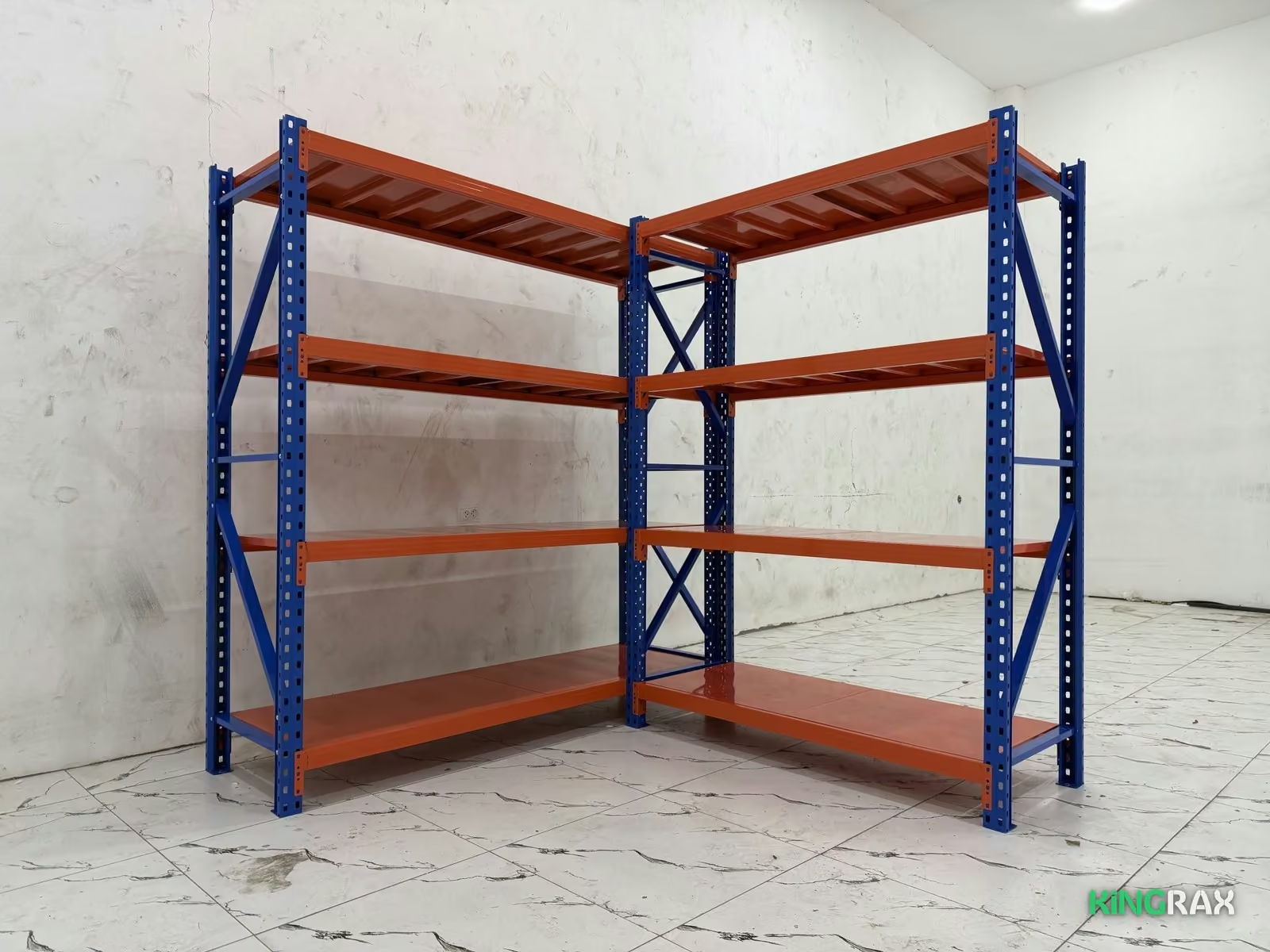
H200/L120/W50
1,102,000 UZS
Aisle width depends on what moves along it. Rough guides (common practice, not a strict rule):
| What uses the aisle | Approximate width |
|---|---|
| One person carrying a box | about 1 m |
| A person with a trolley | from 1.2 m |
| Two people or two trolleys side by side | from 1.5 m |
| Hand pallet jack | about 1.8 m or wider |
Warehouse shelving is 50–60 cm deep, so every metre of the room counts: shelving depth plus aisles must not add up to more than the room's width.
The trolley. If a warehouse trolley has to turn inside the aisle, the aisle should be at least as wide as the trolley's diagonal. The warehouse trolleys on the Store Equipment page: the large one is L86/W58 cm (a diagonal of about 1.04 m), the small one L70/W45 cm (about 0.83 m). Add room for the handle and for the person pushing it.
Shelf depth. Warehouse Shelving depth: light-duty racks are 50 cm deep, medium- and heavy-duty racks 60 cm. Someone taking a box off a shelf stands in front of the rack and pulls the box towards them, and part of the aisle goes to that.
How many people work there. If two people work in the warehouse at the same time, they need to pass each other without waiting. In a small storeroom with one person, a narrow aisle is enough.
Rack height. Medium-duty racks come 200, 250 and 300 cm high. You reach the top shelf of a tall rack with a stepladder, and it needs to stand steadily in the aisle.
The calculation is simple: room width = shelving depth + aisles. A medium-duty rack is 60 cm deep; two racks placed back to back (a double row) take 1.2 m.
| Layout | Calculation | With 1.2 m aisles | With 1.5 m aisles |
|---|---|---|---|
| Along two walls, aisle in the middle | 0.6 + aisle + 0.6 | 2.4 m | 2.7 m |
| Along two walls with a double row in the middle | 0.6 + aisle + 1.2 + aisle + 0.6 | 4.8 m | 5.4 m |
| Along two walls with 2 double rows | 0.6 + aisle + 1.2 + aisle + 1.2 + aisle + 0.6 | 7.2 m | 8.1 m |
With light-duty racks (50 cm), each row of shelving takes 10 cm less: for example, the second layout with 1.2 m aisles fits into 4.4 m.
Racks placed back to back are two separate rows: they don't share uprights, and each is counted with its own. Racks standing side by side do share an upright — see Warehouse shelving runs.
We place racks along both walls and one double row in the middle: 0.6 + 1.2 + 0.6 = 2.4 m goes to shelving, and the remaining 3.6 m makes two 1.8 m aisles. A trolley turns easily in an aisle like that, and a pallet jack fits through.
The rows are about 8 m long, leaving roughly 2 m on the door side for a cross aisle and an unloading area. Four L200 racks fit into 8 m; four rows make 16 racks.
Medium-Duty Rack H200/L200/W60, each row made of 1 kit and 3 add-on sections:
| Calculation | UZS |
|---|---|
| 1 kit | 2,205,000 |
| 3 add-on sections × 2,020,000 | 6,060,000 |
| One row | 8,265,000 |
| 4 rows | 33,060,000 |
Prices as of 14 November 2026. Buying all 16 racks as separate kits would cost 35,280,000 UZS, so the add-on sections save 2,220,000 UZS.
Send us the warehouse dimensions and where the doors and windows are, and a manager will prepare a free 2D/3D layout with the rows, aisles, number of racks and price. Choosing the rack type: Choosing warehouse shelving. Ready-made sets: Shelving for warehouses. Aisles on a shop floor work differently: How wide should the aisles in a shop be.


Enter the length of a wall or a row to see which shelving fits and what it costs. You can also get a rough layout from the room size.
