

H195/L100/W50
1,225,000 UZS
Shelving mistakes usually show up on installation day: a unit doesn't fit, an aisle turns out too narrow, or the end of a run is left open. Check these 7 points beforehand and you avoid reordering and extra costs.
| Mistake | How to avoid it |
|---|---|
| Ordering without measuring | Measure columns, doors, windows and radiators too |
| Narrow aisles | 110 cm in a shop up to 50 m², 125 cm up to 100 m² |
| The wrong height | Tall along the walls, low rows in the middle |
| A system that doesn't suit the goods | 40/35 for large packs |
| A forgotten upright | One extra upright per run |
| Accessories left for later | Price holders, stoppers, panels with the shelving |
| Heavy loads on retail shelving | Warehouse racks for heavy goods |
A wall looks long enough, but a column, door, window, radiator or electrical cabinet gets in the shelving's way. Measure each wall separately and mark all of these on a sketch. The floor must be level too: on an uneven floor the unit leans and the load shifts to one side. In Tashkent and Samarkand we measure the space ourselves: Measuring and Installation.
Aisles get squeezed to fit in more shelving, and then customers can't pass with a trolley and two people can't get by each other. Our calculator sets the aisle by the shop's floor area: 110 cm up to 50 m², 125 cm up to 100 m², 145 cm up to 150 m². More detail: How wide should the aisles in a shop be.
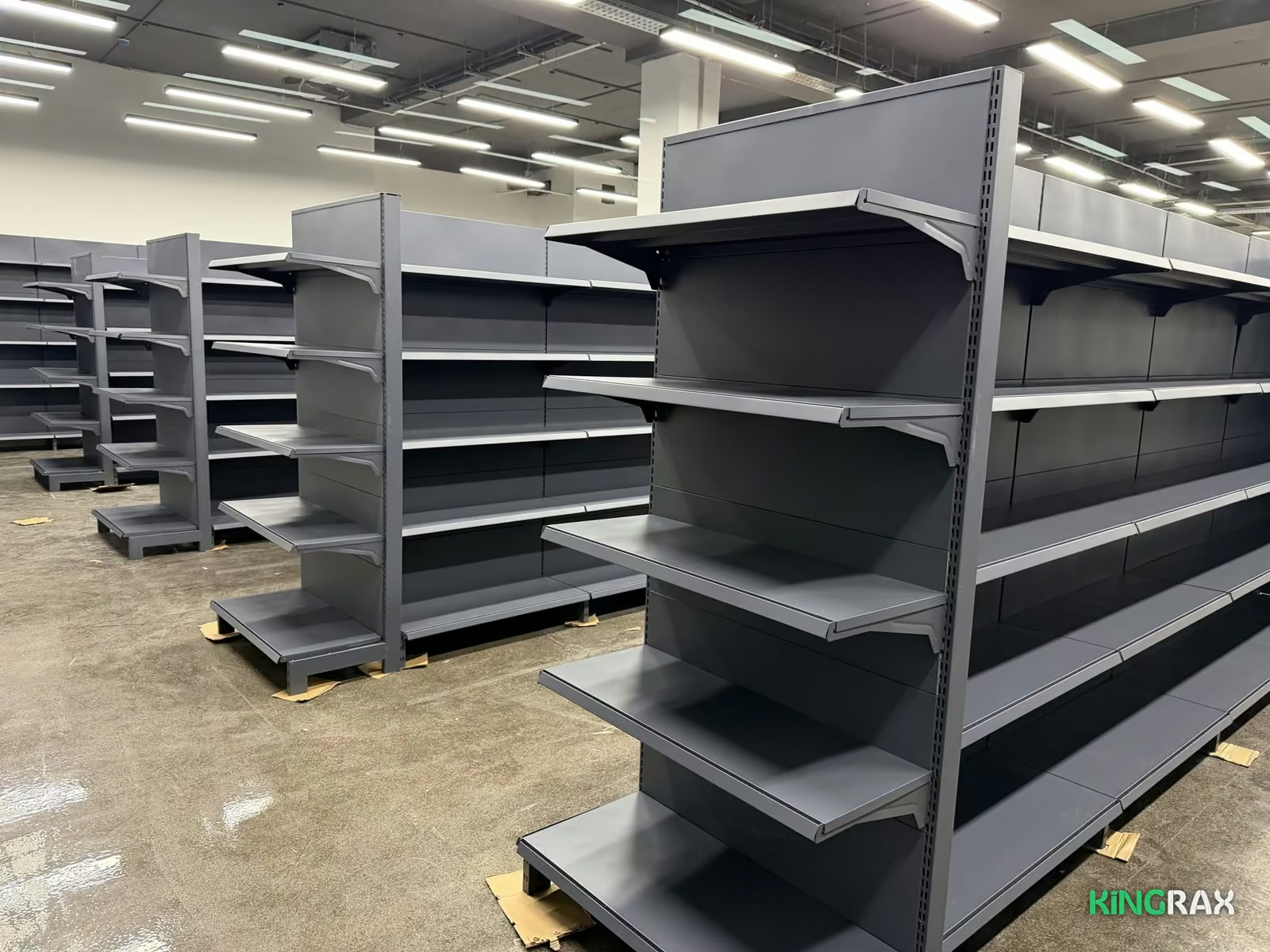
All heights: Shelving sizes.
In the 35/30 system the bottom shelf is 35 cm deep and the rest are 30 cm; in 40/35 they are 40 and 35 cm. Large packs and boxes stick out of a 30 cm shelf. In a small shop, though, 40/35 takes space from the aisles: its double-sided row is 13 cm wider. Which to choose: 35/30 or 40/35.
A wall shelving set includes 1 upright, because neighbouring units share an upright. So every run needs one more upright to close its start. For example, a 3 metre run (H195/L100/W50) is 3 units plus 1 Single-Sided Upright (184,000 UZS), 3,859,000 UZS in all. Double-sided runs are the same: one Double-Sided Upright (H165/W80, 184,000 UZS) at the start of the run. Forget it, and one end of the run stays open on installation day.
If price holders, stoppers and back panels aren't ordered with the shelving, they have to be delivered and fitted separately, so time and delivery are spent twice. A price holder or stopper for an L100 shelf starts at 12,000 UZS; goods on hooks need a perforated or mesh panel, since hooks don't fit a plain one. More detail: Price holders and stoppers, Back panel types.
Retail shelving is made to show goods. Heavy bags, buckets and boxes of back stock call for warehouse racks: light-, medium- and heavy-duty. Tell the manager how heavy your goods are, and they will pick the right rack. The difference: Retail or warehouse shelving. Fix shelving as the instructions say: shelving that isn't fixed isn't covered by the warranty. The rules: Assembling and using shelving safely.
The price depends on size, system, type and accessories, so compare offers with the same sizes and system: What affects shelving price. Found the same factory shelving cheaper elsewhere? See the Best Price Guarantee.
Send us the room dimensions, and in a free 2D/3D layout we'll work out the layout, heights, system, uprights and accessories, so mistakes show up before installation.


Enter the length of a wall or a row to see which shelving fits and what it costs. You can also get a rough layout from the room size.


