KingRax / Guides / Online store warehouse shelving: picking and packing orders
Online store warehouse shelving: picking and packing orders
No customers walk around an online store's warehouse: the shelving isn't there to show goods off, but to pick orders quickly and without mistakes. So this is a job for warehouse racks, every shelf gets an address, and the best-sellers sit close to the packing area.
Doston J, KingRax Warehouse Manager14.11.2026
What for
Product
Price, UZS
Small, light goods
Light-Duty Rack H200/L200/W50
1,470,000
Heavier boxes
Medium-Duty Rack H200/L200/W60
2,205,000
Extending a run
Add-on section, light-duty L200
1,338,000
Moving boxes
Small Metal Warehouse Trolley H20/L70/W45
674,000
Prices as of 14 November 2026.
An address for every shelf
The address is the run, the rack and the level. For example, B-03-2: run B, rack 3, level 2. Stick the label on the front beam.
Every product has its own address. In your stock spreadsheet or software, the address sits next to the product name, so when an order comes in, staff go straight to the right shelf instead of searching.
One address, one product. When goods of a similar colour or size sit side by side, mistakes multiply: put them on different levels.
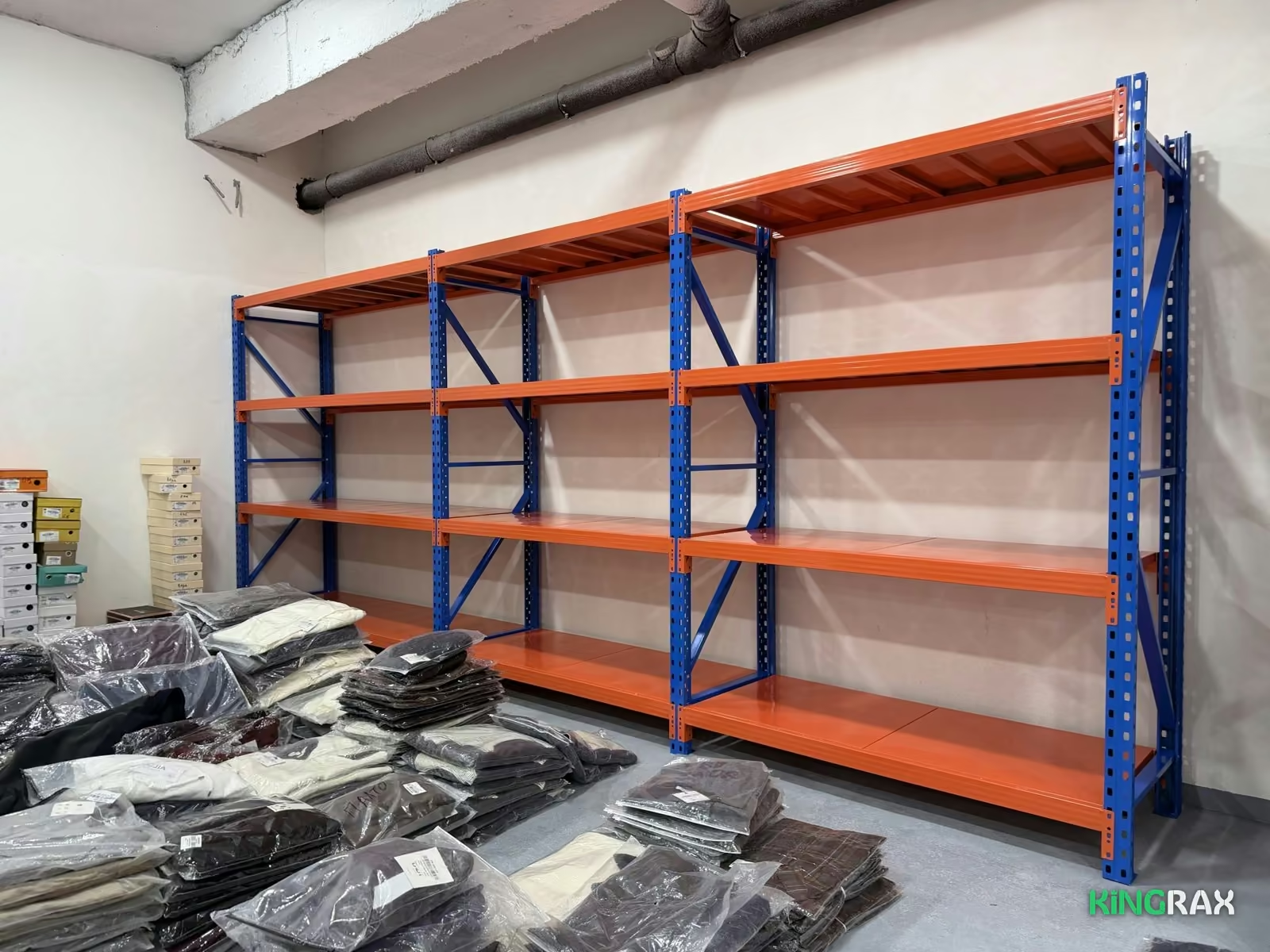
Three warehouse shelving bays along a wall, with packed clothing on the floor
Best-sellers close to packing
The most-ordered goods go on the racks nearest the packing area, on levels 2 and 3, so staff don't have to bend down or fetch a ladder.
Slow sellers and back stock go on the upper levels and in the far runs.
Heavy goods on the bottom level.
Review it once a month: sales change, seasonal goods move to the front and slow sellers move back.
Light-duty or medium-duty
Light-duty rack: 200 cm high, 50 cm deep, 4 levels; 120, 150 or 200 cm long. An L120 has 1 shelf per level; L150 and L200 have 2. For small packed goods such as clothing, cosmetics, accessories and books.
Medium-duty rack: 200, 250 or 300 cm high, 60 cm deep. For heavier boxes and tall back stock; the top level of H250 and H300 racks is reached with a ladder.
Tell the manager how heavy your goods are, and they will pick the right rack. More detail: Choosing warehouse shelving.
Assemble and use racks properly: heavy boxes don't go on the top level, and tall racks are reached with a ladder. The rules: Assembling and using shelving safely.
Aisles and the packing area
If orders are picked with a trolley, make the aisle wider than 1.2 m: Warehouse aisle width.
Leave about 2 m by the door for receiving goods, packing and finished orders.
A separate rack for finished orders, so you don't hunt for the parcel when the courier arrives.
A separate shelf for returns, so unchecked goods don't mix with the main stock.
Keep packing materials (boxes, tape, film) on their own rack next to the packing area, so staff don't walk to the far end of the warehouse for every order.
Example: a 7 × 8 metre warehouse
The room is 7 m wide: one run along each of the two walls and two back-to-back runs in the middle, so 0.5 + 1.0 + 1.0 + 0.5 = 3 m goes to shelving. The remaining 4 m makes three aisles of about 1.3 m each, so a trolley passes easily. The runs are 6 m long, leaving 2 m by the door for receiving and packing. Three L200 racks fit in 6 m: 6 rack runs in all, 18 racks.
Light-Duty Rack H200/L200/W50, each run is 1 set and 2 add-on sections:
Calculation
UZS
1 set
1,470,000
2 add-on sections × 1,338,000
2,676,000
One run
4,146,000
6 runs
24,876,000
An add-on section is 1 upright frame, 8 beams and 8 shelves: it shares a frame with the rack before it. Buying all 18 racks as separate sets would cost 26,460,000 UZS, so add-on sections save 1,584,000 UZS.