KingRax / Guides / Production workshop shelving: raw materials and finished goods
Production workshop shelving: raw materials and finished goods
In a workshop, shelving serves the production flow: raw materials by the receiving door, work in progress by the workstations, finished goods by the dispatch door. Warehouse racks do this job: they are built for heavy loads.
Doston J, KingRax Warehouse Manager14.11.2026
Zone
Shelving
Price, UZS
Raw materials
Medium-Duty Rack H250/L200/W60
2,328,000
The heaviest materials
Heavy-Duty Rack H200/L200/W60
3,185,000
Small parts, packaging
Light-Duty Rack H200/L120/W50
1,102,000
Moving goods
Large Metal Warehouse Trolley H20/L86/W58
796,000
Prices as of 14 November 2026.
Three zones: materials, workstations, finished goods
Raw materials by the receiving door, so goods unloaded from a truck aren't carried across the whole workshop.
Work in progress by the workbenches, on a small rack, where it waits for the next stage.
Finished goods by the dispatch door, so they load onto the truck quickly.
Keep raw materials and finished goods apart: separate runs and a label on every level. Even a new worker quickly finds where everything is.
A separate shelf for rejects, so they don't mix with good products until they've been checked.
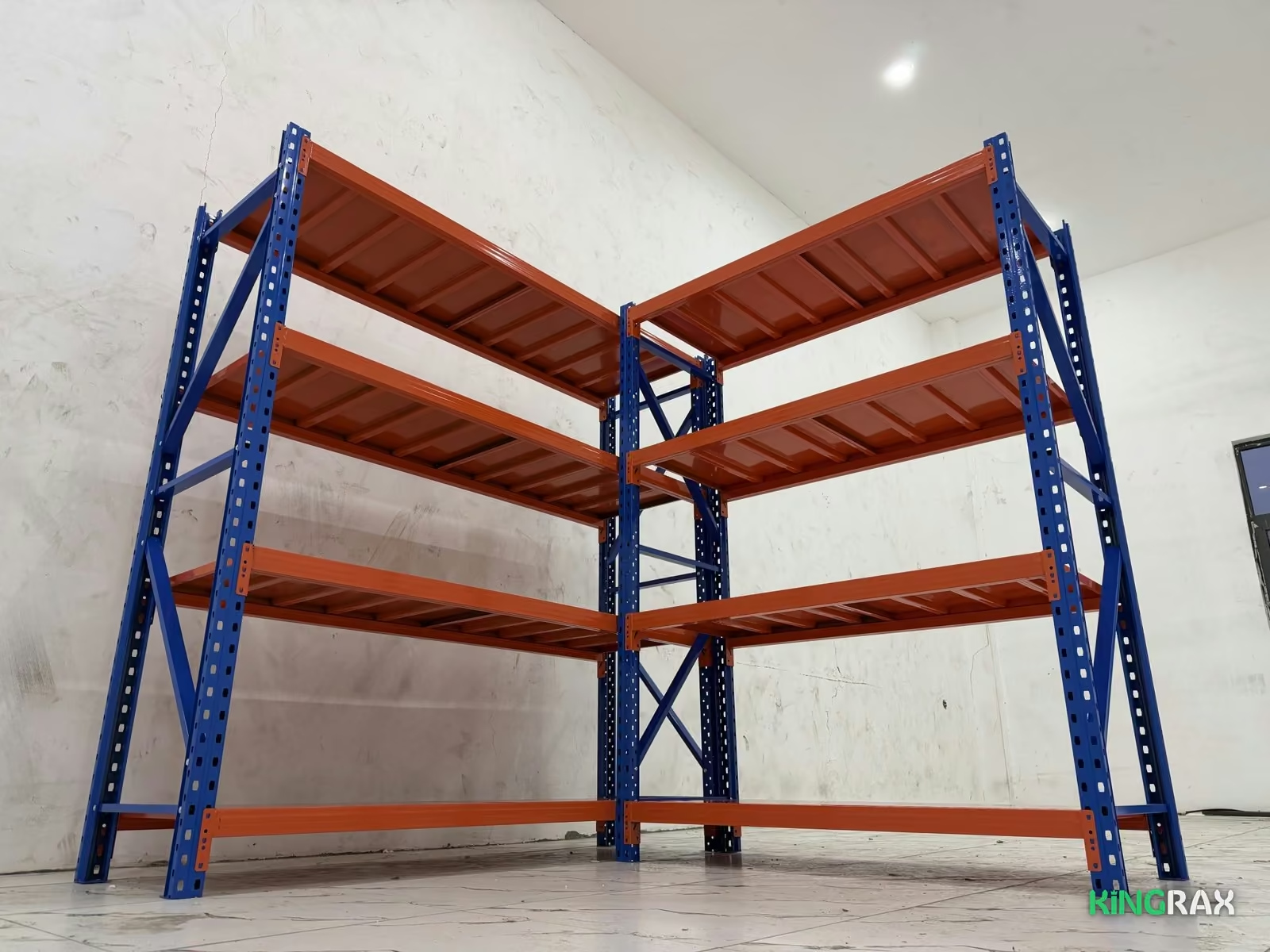
Two runs of warehouse shelving in an L shape: blue uprights, orange shelves
Which rack
Medium-duty rack: 200, 250 or 300 cm high, 60 cm deep, 4 levels, 120, 150 or 200 cm long. The main rack for most workshops; the tall H250 and H300 use the space right up towards the ceiling.
Heavy-duty rack: 200 cm high, 60 cm deep, 4 levels, for the heaviest materials.
Light-duty rack: 200 cm high, 50 cm deep, for small parts, packaging materials and light goods.
Tell the manager how heavy your goods are, and they will choose the right rack. More detail: Choosing warehouse shelving.
Heavy loads on the bottom level; the top level of a tall rack is reached with a ladder. Racks are fixed as the instructions say: Assembling and using shelving safely.
Aisles and moving goods
If you work with a trolley, make the aisle wider than 1.2 m; for a hand pallet truck, about 1.8 m or more. More detail: Warehouse aisle width.
Warehouse trolleys: the large L86/W58 is 796,000 UZS, the small L70/W45 674,000 UZS.
Don't leave goods in the aisle: trolleys can't pass and people trip.
Mark a drop-off spot in front of each rack, where goods from a trolley wait without blocking the aisle.
Records and growth
Give every level an address: run, rack and level (for example, X-02-3). Counting stock and finding the right box gets easier.
Record what comes in and goes out, so you can see which materials arrived when and went into production when, and old stock doesn't sit forgotten.
When production grows, runs are extended with add-on sections: factory shelving is assembled from parts, with no welding needed.
Dust and damp
Workshops are dusty: wipe the shelving with a damp cloth and a mild cleaner, then dry it. Solvents, abrasive powder and wire brushes damage the paint. Shelving is for dry rooms: use in damp places isn't covered by the warranty. More detail: Metal shelving care.
Example: an 8 metre run, H250
Four Medium-Duty Racks H250/L200/W60 fit along an 8 m wall. The first in the run is a full set and the other three are add-on sections, each sharing an upright frame with the rack before it.
Calculation
UZS
1 set
2,328,000
3 add-on sections × 2,082,000
6,246,000
One run
8,574,000
Two runs: raw materials and finished goods
17,148,000
An add-on section is 1 upright frame (H250), 8 beams and 8 shelves. Building each run from separate sets would cost 9,312,000 UZS, so add-on sections save 738,000 UZS per run.