KingRax / Guides / Spice and tea shop shelving: packets, jars and sacks
Spice and tea shop shelving: packets, jars and sacks
A spice and tea shop sells three kinds of goods: small packets, glass and plastic jars, and heavy sacks of goods sold by weight. Packets go on hooks, jars on a shelf with a stopper, and sacks on the bottom shelf. Tea absorbs the smells around it, so it stands apart from the spices, on a different unit.
Avazbek, KingRax Samarkand Manager14.11.2026
Goods
Where
Accessory and price
Small packets
On hooks
Hook-Rail Shelf L100/W35 — 196,000
Jars, boxes
On a shelf with a stopper
Stopper L100 — 12,000
Packaged tea
On a slanted basket shelf
Slanted Mesh-Basket Shelf L100/W35 — 196,000
Heavy sacks
Bottom shelf
—
Prices in UZS as of 14 November 2026.
Keep tea and spices apart
Tea absorbs the smells around it: put it on another wall or unit, away from pungent spices.
Strong-smelling spices (cumin, pepper, garlic powder) go in one place, so the smell doesn't spread through the shop.
Away from sun and heat: in direct sunlight spices quickly lose colour and aroma, so only closed packs go near the window.
Keep them dry too: damp spices clump. Put the shelving in a dry spot, and don't let water splash onto the shelves when the floor is mopped.
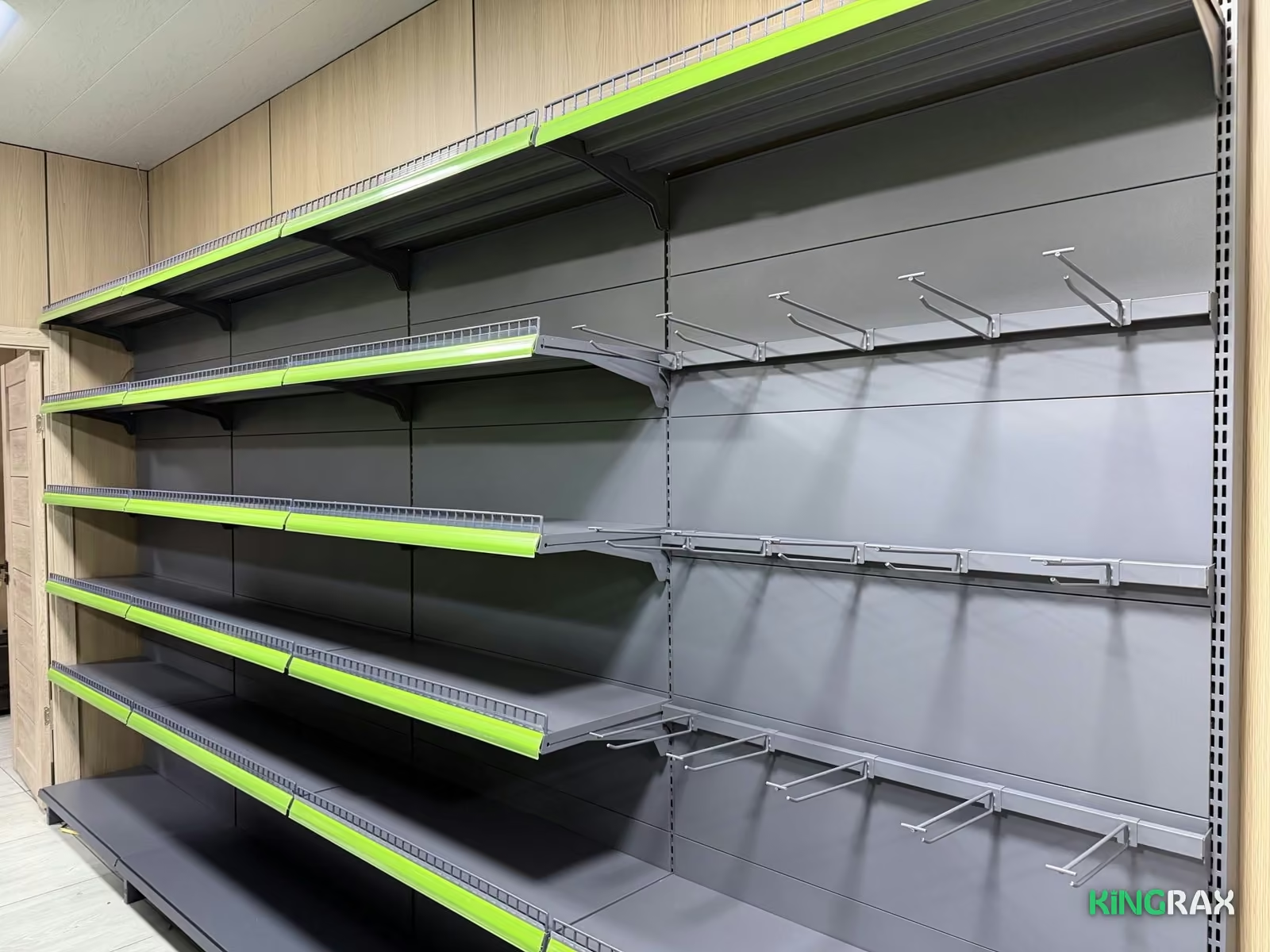
Nam Asfalt (wet asphalt) wall shelving: shelves with green price holders on the left, hook-rail shelves on the right
Packets on hooks
Spices in small packets hang on a hook-rail shelf (L100/W35 — 196,000 UZS): it replaces an ordinary shelf, with one kind of spice per hook.
Rows by type: spices for plov, kinds of pepper, spices for sweets and baking, so customers find the packet they need quickly.
A price under every hook: hook-rail shelves have their own price holders.
So glass jars don't slide off, fit a stopper on the shelf edge (L100 — 12,000 UZS). More detail: Price holders and stoppers.
Line up identical jars, labels facing the customer, so the name and price can be read from the aisle.
Boxes of tea look good on a slanted mesh-basket shelf: the basket tips the goods towards the customer.
Heavy sacks and the scales
Sacks of goods sold by weight on the bottom shelf, next to the scales, so the seller doesn't carry them around.
With a lot of sacks, a warehouse rack in the stockroom suits the back stock: Shop stockroom shelving.
Scales and till near the entrance: customers choose, weigh and pay in one spot.
Keep packing materials (bags, paper bags) on a shelf next to the scales.
Freshness and samples
Older stock at the front, newer at the back: when restocking, put the fresh packs behind, so goods with the shorter shelf life sell first.
A sample of each kind in a small lidded dish by the scales: customers can smell it, and the opened spice doesn't get damp.
Price goods sold by weight per 100 grams or per kilogram, so customers can compare easily.
Example: a 4 × 4 metre shop
The shop floor is 4 × 4 m (16 m²). By the calculator's rules: two L120 on the back wall, an L100 and an L70 on each side wall, one double-sided L90 unit in the middle and inner corner units in the back corners; a 110 cm aisle.
Plan of a 4 × 4 m spice and tea shop: units along the walls and one unit in the middle, entrance at the bottom Calculate with this size
Calculator total, 35/30
Qty
UZS
Wall shelving H195
6
6,860,000
Double-sided shelving H165
1
1,838,000
Inner corner shelving H195
2
2,572,000
Uprights at the row ends
4
736,000
Total
12,006,000
Hook-rail shelves, stoppers and price holders come on top. For example, one hook-rail shelf (L120/W35, 196,000 UZS) for spice packets on each of the two L120 units on one wall adds 392,000 UZS.