Baby goods shop shelving: nappies, baby food and hygiene
A baby goods shop sells three kinds of goods: big, light packs of nappies (diapers), baby food in jars and boxes, and small hygiene items. Nappies go on the bottom — deepest — shelf, with the back stock on a warehouse rack in the stockroom. Glass jars go on the middle shelves behind a stopper, small items on hooks and in divider boxes.
Jalol Murad, KingRax General Manager17.11.2026
What
Size
Price, UZS
Wall shelving, 35/30
H195/L100
1,164,000
Wall shelving, 40/35
H195/L100
1,225,000
Hook for a perforated panel
W30
24,000
Shelf divider box
H20/L30/W25
160,000
Stopper
L100
12,000
Light-duty rack
H200/L200/W50
1,470,000
Prices as of 17 November 2026.
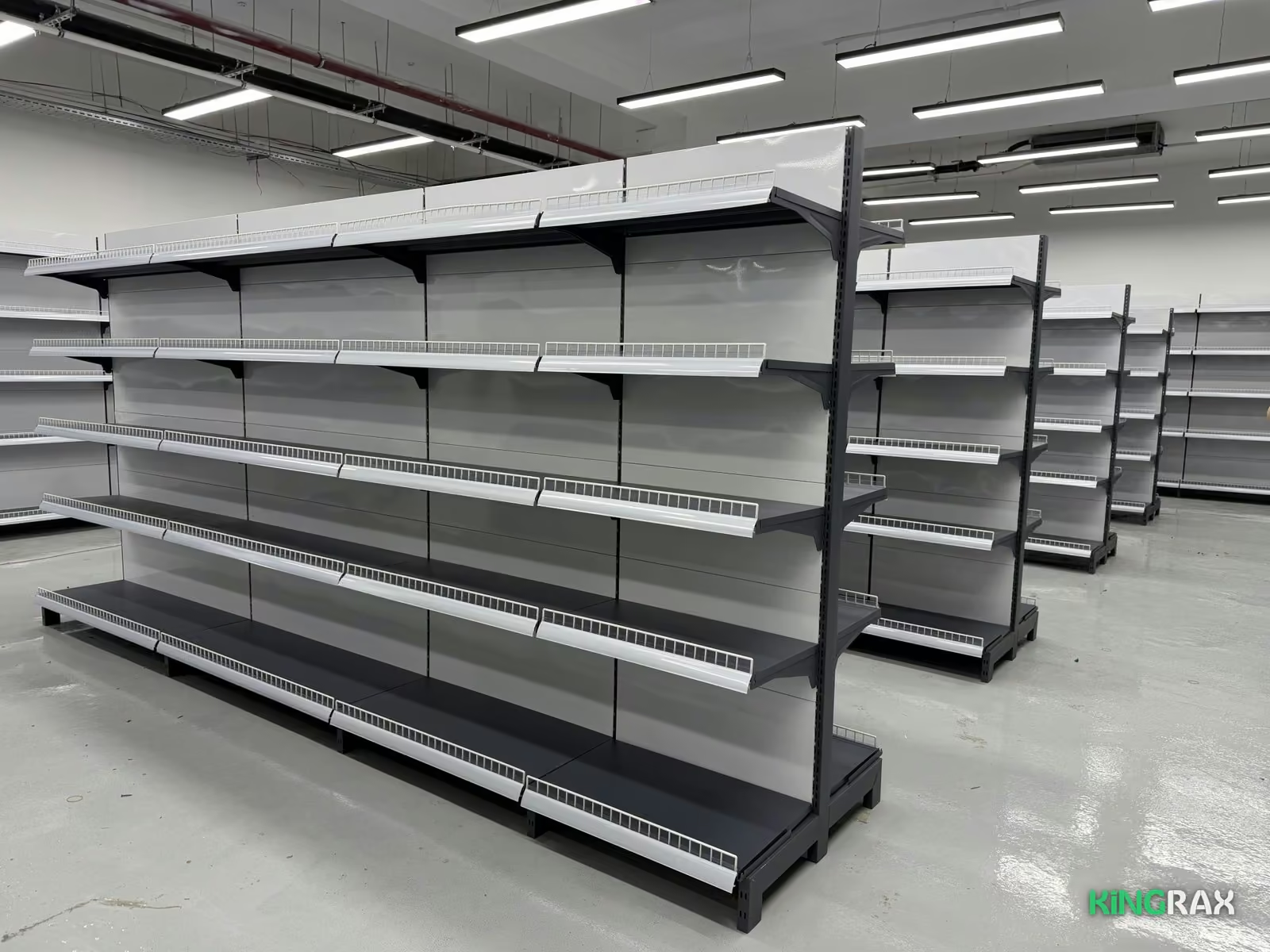
Rows of double-sided shelving in a large sales hall: dark grey uprights with white panels and shelves
Nappies: big, light and fast-selling
Nappies are the everyday product of a baby goods shop: people buy them often and in big packs, so they need plenty of room on the shop floor.
On the shop floor: the deep bottom shelf
The bottom shelf is the deepest. In the 35/30 system the bottom shelf is 35 cm deep and the others 30 cm; in 40/35 they are 40 and 35 cm. Measure the biggest pack you stock: if it sticks out of a 35 cm shelf, take the 40/35 system. The difference: 35/30 or 40/35.
On the back wall. When everyday goods are at the back of the shop, customers walk past the other sections on their way: Dividing a store floor into zones.
By size. In order of the size number on the pack, smallest to largest, with a price holder under each size.
Room for tall packs. If a pack does not fit between two shelves, take one shelf out: any shelf except the bottom one can be removed.
Small packs on top. Nappies are light, but do not put a big pack above head height: it is awkward to reach and slips out of the hands.
How many packs fit on a shelf is a simple sum: shelf length ÷ pack width.
Back stock: in the stockroom
On the shop floor nappies run out fast, so their back stock is kept in the stockroom. The stockroom needs a light-duty rack rather than retail shelving: 200 cm high, 50 cm deep, 4 levels, 120, 150 or 200 cm long. For light packs that are put on and taken off by hand, like nappies, this type is enough: each level takes up to 75 kg at L120 and L150 and up to 100 kg at L200. If heavier boxes will be stored there too, choose a medium-duty rack — up to 200–300 kg per level.
Two racks side by side share one upright: the second one is an add-on section (1 upright, 8 beams and 8 shelves).
Light-duty, H200/L200/W50
UZS
1 full set
1,470,000
1 add-on section
1,338,000
Total, a run of about 4 m
2,808,000
More: Warehouse shelving runs. Sort the back stock by size and label every level; keep food and chemicals on separate levels or separate racks. Planning the room: Shop stockroom shelving.
Baby food: jars, boxes and pouches
Glass jars — on the middle shelves, behind a stopper. A jar that falls from the top breaks, and on the lowest shelf a small child can reach it. A stopper holds the jars at the shelf edge; from L50 to L120 it costs 12,000 UZS.
Boxes — at eye and hand level. Parents choose dry formula and baby cereal by reading and comparing the labels; put a price holder under each product.
Pouches (fruit puree and juice) — on a straight mesh-basket shelf: the pouches sit in the basket and do not fall off the shelf (L70 – L120, 172,000 – 196,000 UZS).
Group by the age shown on the pack: parents find what they need in one place.
Hanging packs (pacifiers, combs, nail scissors) — on hooks. A hook hangs on a perforated or mesh back panel, not on a solid one: Back panel types. A hook for a perforated panel (W30) costs 24,000 UZS, one for a mesh panel 36,000 UZS.
Hook-rail shelf (L70 – L120, 172,000 – 196,000 UZS) — it comes with its own rail and hooks and replaces a standard shelf.
Small boxes and tubes (cream, toothpaste) — in a shelf divider box (H20/L30, 25 or 30 cm deep; 160,000 – 184,000 UZS): each product stays in its own box and nothing gets mixed up.
Wet wipes, shampoo, soap — on a standard shelf. A stopper in front of round bottles, a price holder under every product.
9 m from the entrance to the back wall, 4.5 m wide (40.5 m²). By the calculator's rules: three units on the back wall (L100, L100, L90), six on each side wall (four L120, L100 and L90), one double-sided row in the middle (L120, two L100 and three L90), and inner corner units in the back corners.
Plan of a 9 × 4.5 m baby goods shop: units along the walls, one double-sided row in the middle, entrance at the bottom Calculate with this size
Shelving, 35/30
Qty
Total, UZS
Wall, H195
15
18,070,000
Double-sided, H165
6
11,516,000
Inner corner, H195
2
2,572,000
End uprights for the runs
4
736,000
Total
32,894,000
Sections on the shop floor:
Back wall and corners — nappies. Big packs on the deep bottom shelves.
One side wall — baby food, the other — hygiene and care. Laundry products go on the hygiene wall, away from the food.
Middle row — small items: hooks and divider boxes. Each side of the row continues the section on the wall it faces: feeding bottles and pacifiers on the food side; combs, scissors and cotton buds on the hygiene side.
Aisles on both sides of the middle row are about 1.4 m wide. That is wider than the 100–120 cm recommended for this floor area, so a baby stroller passes easily (How wide should the aisles in a shop be).
1.5 m at the front — the calculator leaves it free for the entrance and the checkout.
The calculator works in the 35/30 system. In 40/35 the units are deeper and cost more, and the runs are made up differently — the manager will work out such a layout free of charge. Prices as of 17 November 2026; accessories and stockroom racks come on top.
Safety
Fix the shelving. Small children come into the shop too: assemble the units on a level floor according to the instructions and fix them in place. Shelving installed on an uneven floor or left unfixed is not covered by the warranty.
Heavy goods at the bottom. Packs of juice and water go on the bottom shelves, only light goods at the top.
A dry room. Shelving is meant for a dry place: use in a damp place is not covered by the warranty.