KingRax / Guides / Shop window shelving: the spot people see from the street
Shop window shelving: the spot people see from the street
The shop window is the shop's advert on the street: what passers-by see through the glass is what brings them in. So a low unit goes by the glass, the shop floor stays in view, and the window display changes often.
Jalol Murad, KingRax General Manager14.11.2026
What
Product
Price, UZS
By the glass
Double-Sided Shelving H135/L120/W80
1,960,000
Start of the row
Double-Sided Upright H135/W80
184,000
Every shelf
Price Holder L120
12,000
So nothing falls
Stopper L120
12,000
Prices as of 14 November 2026.
Two kinds of window
An open window: the sales floor starts right behind the glass. Passers-by see the goods and the shop, so the unit by the glass has to be low.
A closed window: a separate space between the glass and the shop floor, with a closed back. Clothing and gift shops often have these: goods are staged as on a set, and the shop floor isn't visible.
Low shelving keeps the shop in view
A tall unit by the glass hides the shop: passers-by see the back of the unit, not the goods.
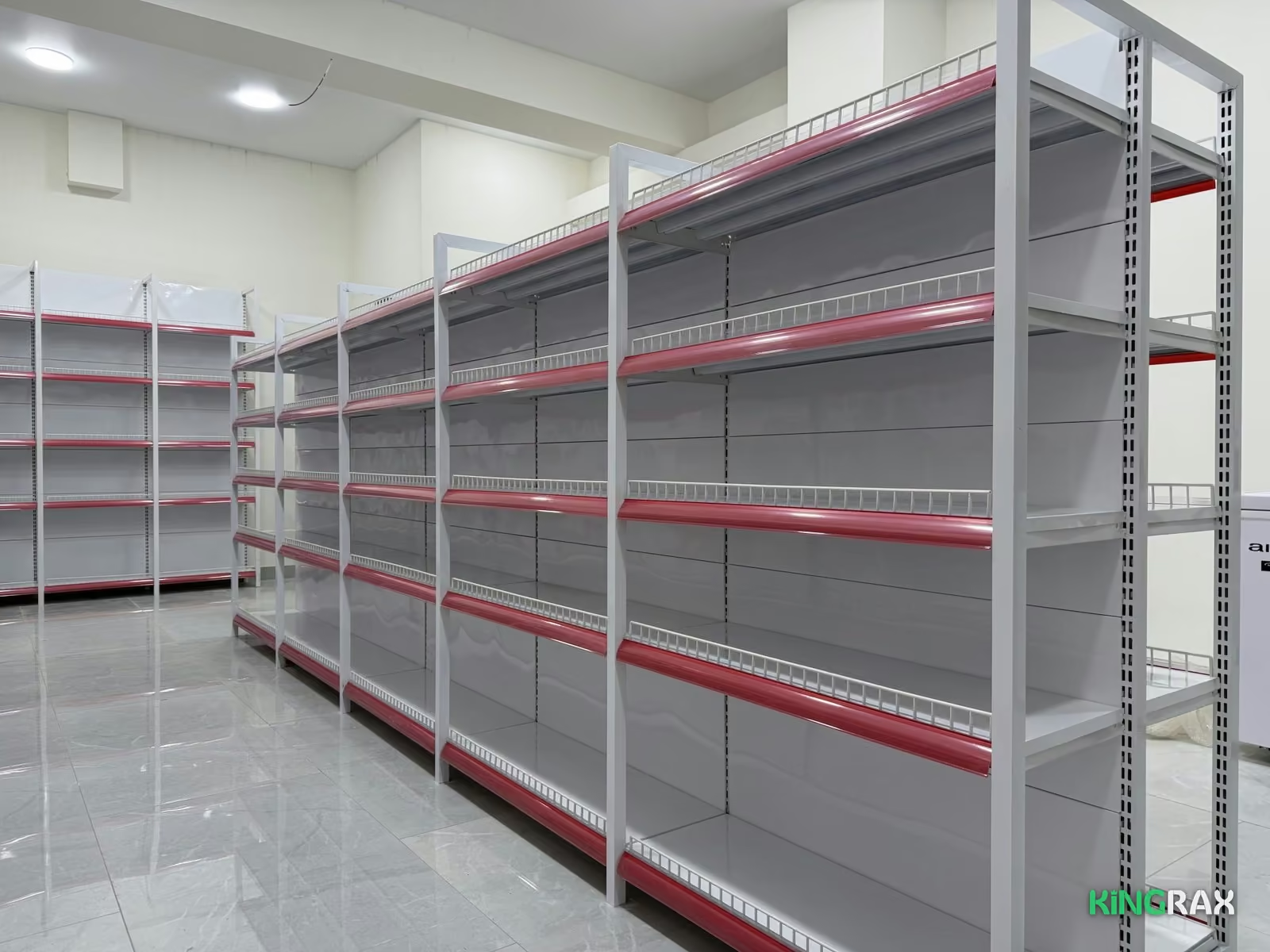
A double-sided H135 unit: one side faces the street, the other the shop, and the whole shop is visible over the top. Each side has 4 shelves.
Don't put wall shelving with its back to the glass: from the street you'd only see the back panel.
If the window is tall and wide, H165 works too, but H135 keeps the shop more visible.
Leave space between the glass and the unit, so cleaning the glass and changing the display are easy. A double-sided unit takes 80 cm of floor space (35/30 system).
Yorqin Oq (bright white) double-sided shelving with red price holders
What goes in the window
The most attractive, newest and promotional goods: whatever shows at a glance what the shop sells.
Little, but eye-catching: a window crammed with goods looks like a storeroom. One or two product groups per shelf, with space between them.
Seasonal goods: before a holiday or new season, the window is the first thing to change. More detail: Holiday and seasonal sales.
Make prices visible from the street: a price holder on every shelf and a large price label for the main product.
Refresh it every week
Passers-by quickly get used to an unchanging window and stop looking. Refresh the window every week or two: change the goods and the colours. Photograph the window after each change, so you can compare which display lifted sales. Write down in advance what goes in each week, just as in a planogram: Planogram.
Sun and heat
In a sunny window, fabric, paper packaging and plastic fade.
Chocolate and other heat-sensitive food warms up in the window, so keep it inside, out of the sun.
Choose sun-proof goods for the window: metal, glass and ceramic items, or packaged samples.
Evenings and security
Light the window in the evening, so passers-by see the goods even when the shop is closed.
Put only a sample of expensive goods in the window; keep the real stock near the seller.
The entrance and the window together
Don't block the space by the entrance: the site's calculator leaves 1.5 m for the entrance and till. The unit by the window must not narrow that path. More detail: Dividing a store floor into zones.
Row ends facing the entrance continue the window: put promotional goods on the end-cap units too. More detail: End-cap shelving.
Example: a 2.4 metre window
Two double-sided H135/L120 units stand side by side in one row by the glass. Each unit has 8 shelves across its two sides, so the pair has 16.
Product
Qty
UZS
Double-Sided Shelving H135/L120/W80
2
3,920,000
Double-Sided Upright H135/W80
1
184,000
Price Holder L120
16
192,000
Total
4,296,000
If you want stoppers, add another 12,000 UZS per shelf.