

H200/L200/W60
2,205,000 UZS
A wholesale store sells by the box and the block, and customers push trolleys. So the floor gets warehouse racks rather than retail shelving: the shelves are deep (60 cm), boxes fit easily, and the racks go up to 300 cm.
| What | Recommendation |
|---|---|
| Racks | Medium-duty or heavy-duty, 60 cm deep |
| Height | 200 cm; with lots of stock, 250 or 300 cm (medium-duty) |
| Aisles | From 1.5 m for trolleys, about 1.8 m for a pallet jack |
| Layout | Selling on the lower and middle levels, stock on top |
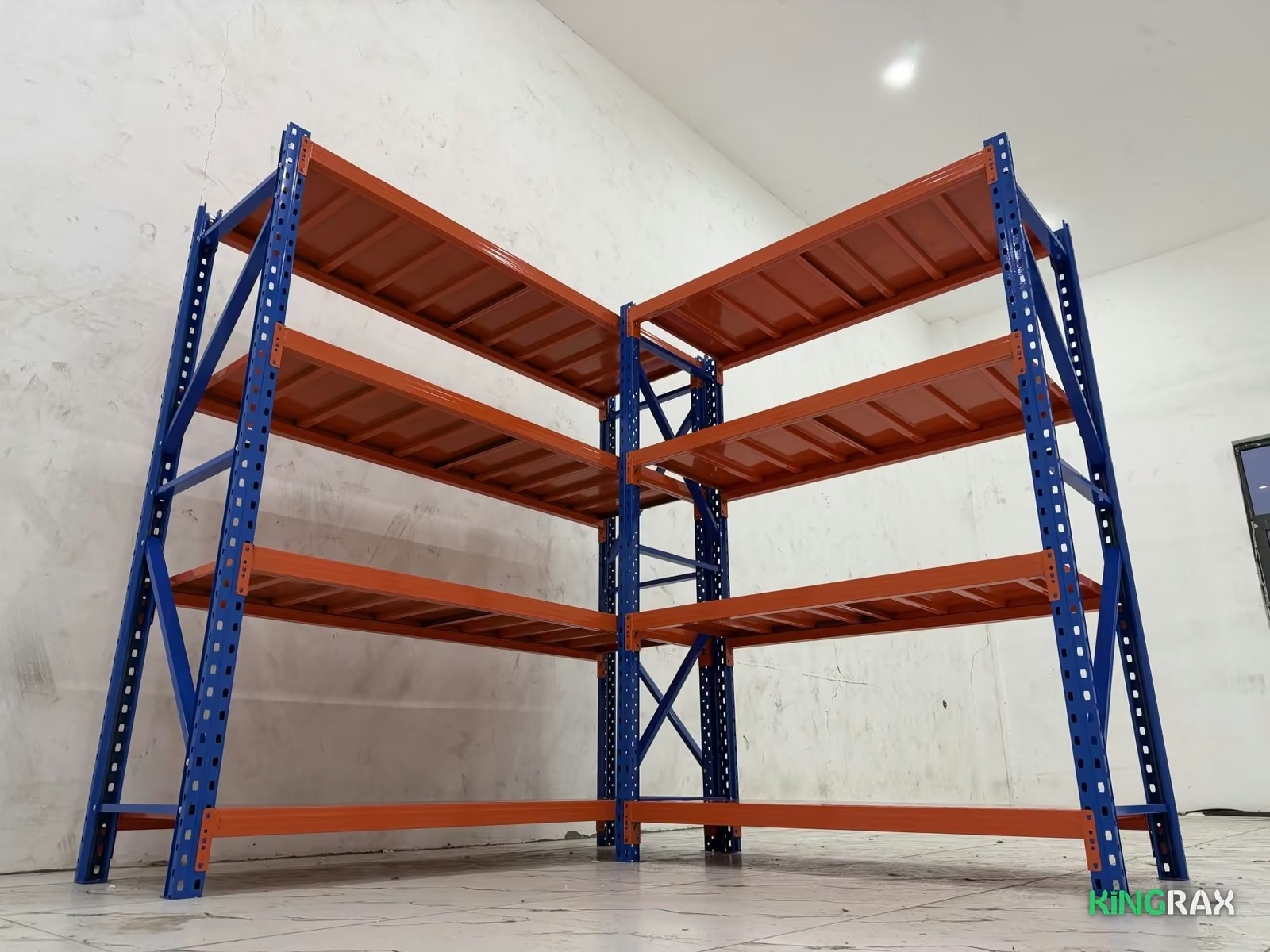
Which duty you need depends on what your goods weigh: Choosing warehouse shelving. A light-duty level takes up to 75–100 kg, a medium-duty one up to 200–300 kg; ask the manager about heavy-duty racks.
Customers walk the floor, so order on tall racks matters even more:
More detail: Assembling and using shelving safely.
The hall is 9 m wide: one run along each wall and 2 double rows in the middle (racks placed back to back). Shelving depth: 0.6 + 1.2 + 1.2 + 0.6 = 3.6 m, and the remaining 5.4 m makes three 1.8 m aisles. The rows are about 8 m long (4 L200 racks each), leaving roughly 4 m by the entrance for the till and trolleys. Six rows in all make 24 racks.
Medium-Duty Rack H200/L200/W60, each row made of 1 kit and 3 add-on sections:
| Calculation | UZS |
|---|---|
| 1 kit | 2,205,000 |
| 3 add-on sections × 2,020,000 | 6,060,000 |
| One row | 8,265,000 |
| 6 rows | 49,590,000 |
Prices as of 14 November 2026. Buying 24 separate kits would cost 52,920,000 UZS, so the add-on sections save 3,330,000 UZS.
Send us the hall dimensions and where the doors and the till are, and a manager will prepare a free 2D/3D layout with the rows, aisles, number of racks and price. Ready-made sets: Shelving for warehouses.


Enter the length of a wall or a row to see which shelving fits and what it costs. You can also get a rough layout from the room size.