
H200/L120/W50
1,102,000 UZS
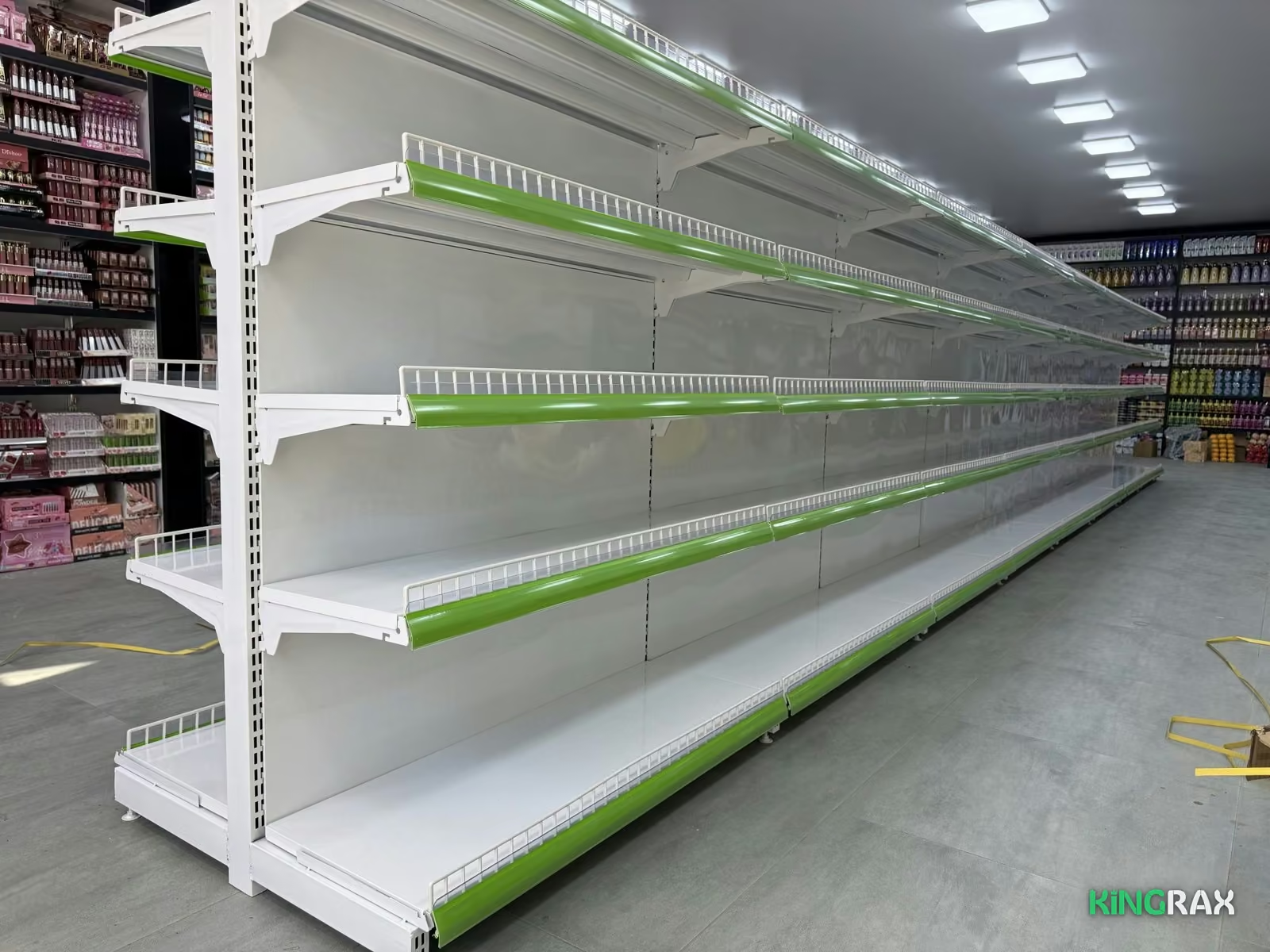
A grocery store needs metal retail shelving: wall shelving along the walls, double-sided (island) rows in the middle of the floor, inner corner units in the corners and end caps at the ends of rows for promotions. If there is a lot of heavy stock — drinks, flour, cooking oil — choose the 40/35 system with deeper shelves; for ordinary packaged goods the 35/30 system is enough.
| Zone | Shelving | Size | Price, UZS |
|---|---|---|---|
| Along the walls: groceries, cans, tea | Wall, 35/30 | H195/ | 1,164,000 |
| Drinks, flour, oil | Wall, 40/35 | H195/ | 1,225,000 |
| Middle of the floor | Double-sided, 35/30 | H165/ | 1,960,000 |
| End of a row: promotions, new items | End cap, 35/30 | H165/ | 1,225,000 |
| Corner | Inner corner, 35/30 | H195, 75 × 75 cm | 1,286,000 |
Prices as of 17 November 2026, per unit. Every shelf needs a price holder: Price Holder L100 — 12,000 UZS.
Wall shelving is single-sided retail shelving: its back stands against the wall and goods are placed from the front. In a grocery store this row usually holds dry groceries, cans, tea and coffee, sweets and household chemicals. Wall units can be H195 or H225: a tall unit uses the whole wall, and the top shelves take light goods and slow sellers. What goes at which height: grocery store merchandising.
Double-sided (island) shelving stands in rows in the middle of the floor, with goods on both sides. In a grocery store these rows are usually H165 or H135 — lower than wall units, so the floor looks more open. Aisle width between rows depends on shoppers and trolleys: store aisle width. How many rows fit: planning double-sided shelving rows.
The system numbers are shelf depths: in 35/30 the bottom shelf is 35 cm and the others 30 cm; in 40/35 — 40 and 35 cm. A grocery store has a lot of heavy and bulky stock: bottled water and drinks, bags of flour and sugar, cooking oil. For it the 40/35 system is more convenient — deeper shelves and a thicker upright profile (7 × 3 cm, 6 × 3 cm in 35/30). Many shops use both: the drinks section on 40/35, the rest of the floor on 35/30. In detail: 35/30 or 40/35, drinks: drinks section shelving.
| Section | What you need | Price, UZS |
|---|---|---|
| Drinks, bottles and jars | Stopper L100 — keeps goods from falling | 12,000 |
| Packaged sweets, small bags | Slanted Mesh-Basket Shelf L100/ | 196,000 |
| Packaged bread | Straight Mesh-Basket Shelf L100/ | 196,000 |
| Chocolate, small packs | Shelf Divider Box H20/ | 184,000 |
Prices as of 17 November 2026. Bread and sweets: bakery and confectionery section; household chemicals go in a separate row from food: household chemicals section.
Fruit and vegetables need not ordinary shelving but fruit and vegetable shelving — a stand with a sloped top. A checkout counter, baskets and trolleys go by the entrance: checkout counters, baskets and trolleys. The stockroom for reserve stock takes cheaper, taller warehouse shelving rather than retail units: shop stockroom shelving.
The number of units comes from the size of the floor: wall shelving along the length of the walls, and double-sided rows with aisles in the remaining space. A ready calculation with an approximate price for a 20, 48 and 96 m² minimarket: how many shelves for a minimarket. Ready layouts for a small 12–30 m² shop: small shop shelving plan.
Send us the size of your shop, and we will draw the shelving layout in a free 2D/3D project.


Enter the length of a wall or a row to see which shelving fits and what it costs. You can also get a rough layout from the room size.
