

H165/L90/W50
1,348,000 UZS
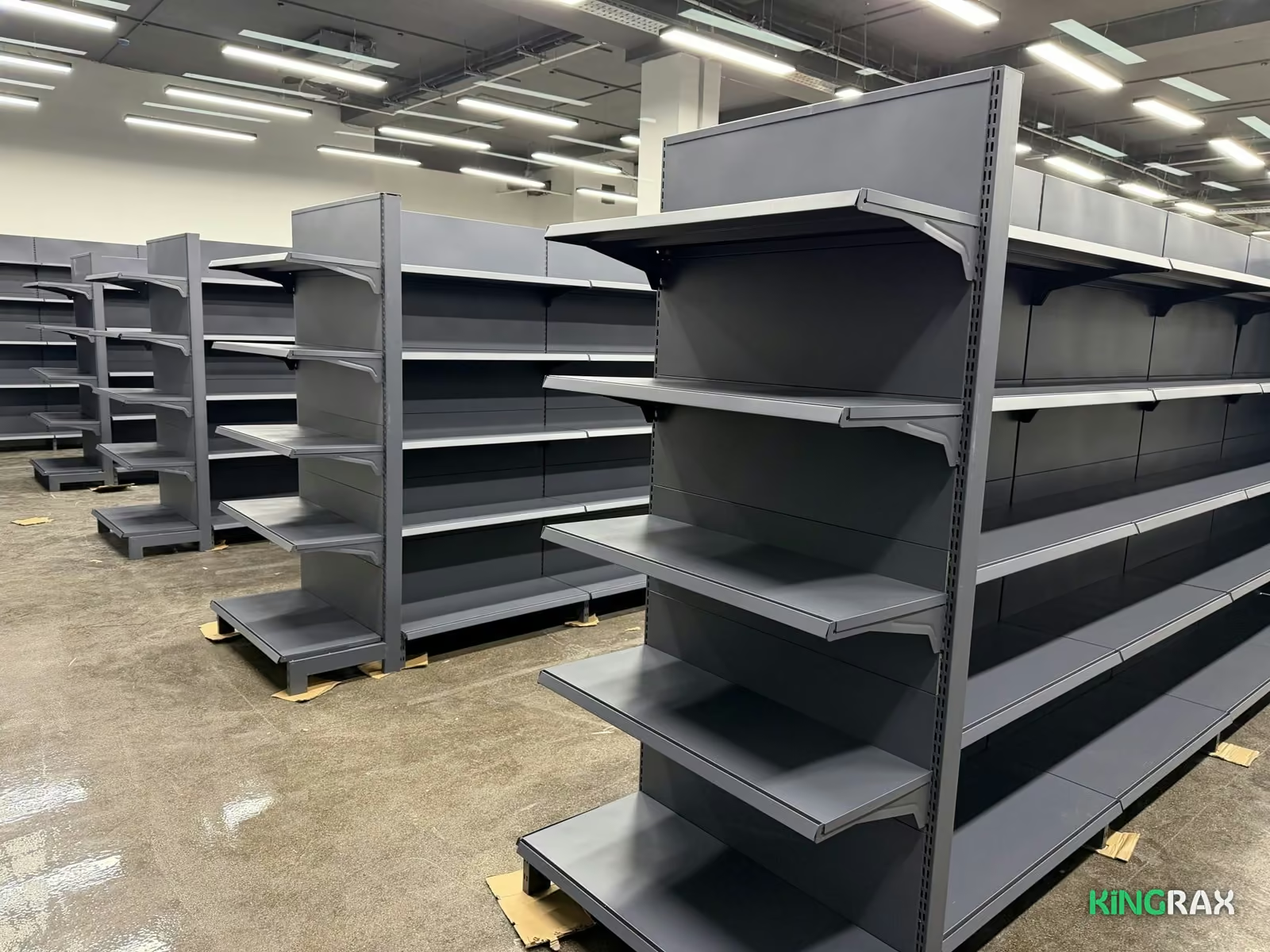
Wall shelving is single-sided: its back stands against the wall and goods go only on the front; double-sided (island) shelving stands in the middle of the floor and holds goods on both sides. Every shop starts with wall shelving and adds double-sided rows when the floor is wide enough: with the 35/30 system one island row needs a room about 3.9 m wide or more.
| Wall | Double-sided (island) | |
|---|---|---|
| Where it stands | Against a wall | In the middle, in rows |
| Goods placed | From one side | From two sides |
| Height | 135–225 cm | 135–195 cm |
| Floor space | 45 cm (35/30), 50 cm (40/35) | 80 cm (35/30), 93 cm (40/35) |
| Price, H165/ | 1,102,000 UZS | 1,960,000 UZS |
| Price of one side | 1,102,000 UZS | 980,000 UZS |
Prices as of 17 November 2026. Each side of a double-sided unit has as many shelves as a wall unit, so one side of it costs less than a wall unit.
Wall shelving is single-sided retail shelving: its back stands against the wall and goods are placed from the front. Every shop needs it, because the walls are the longest free space on the floor. It can be tall (H195, H225): there is no aisle behind it, shoppers come only from the front, and the height of the wall is not wasted. In a small shop the middle of the floor is needed as the aisle, so often only wall shelving is used: small shop shelving plan.
Double-sided (island) shelving is retail shelving for the middle of the floor: it stands in rows and goods are placed on both sides. It is added when the walls are full and there is space left in the middle: grocery stores, minimarkets and supermarkets build their aisles from these rows. It is taken lower than wall shelving (the tallest is H195), and an end cap goes at the end of each row.
For one double-sided row the width of the room must fit five things: the units on both walls, the island row and the aisles on either side of it. With 35/30: 45 cm + 110 cm + 80 cm + 110 cm + 45 cm = 390 cm. With 40/35: 50 cm + 110 cm + 93 cm + 110 cm + 50 cm = 413 cm. 110 cm is the recommended aisle for a shop up to 50 m²; in a larger shop aisles are wider: store aisle width. If the room is narrower, no island row goes in — only wall shelving. How many rows fit: planning double-sided shelving rows.
Most shops use both types: wall shelving along the walls, double-sided rows in the middle, and inner corner units where the wall rows meet in a corner. If both types are taken in the same system (35/30 or 40/35), their shelves and accessories fit each other. All types in one table: types of shelving.
Send us the size of your room, and in a free 2D/3D project we will show which type fits where.


Enter the length of a wall or a row to see which shelving fits and what it costs. You can also get a rough layout from the room size.